What is a funding rate in crypto perpetual futures? A plain explanation
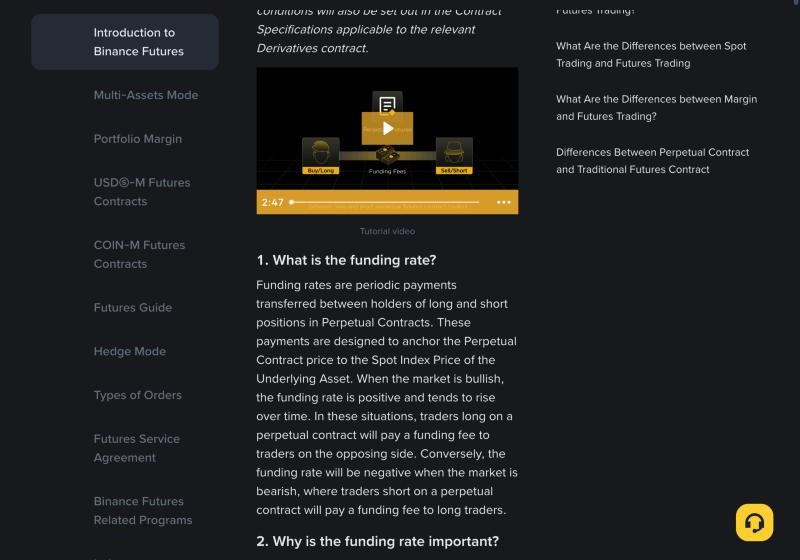
A funding rate is a regular payment between traders holding opposite sides of a perpetual futures contract. It exists because a perpetual contract never expires, so something else has to keep its price close to the underlying asset. When the rate is positive, longs pay shorts; when it is negative, shorts pay longs. The exchange sets the formula but, on the major exchanges, the money moves between traders.
Funding is a recurring transfer between longs and shorts, calculated as position value × funding rate at each settlement. You pay or receive it only if you hold a position at the settlement moment, and the size depends on your position value rather than your margin.
Why perpetual futures need a funding rate
A traditional futures contract has an expiry date. On that date it settles against the underlying price, and traders know the two prices must meet. That known meeting point pulls the contract price toward the spot price as expiry approaches, because anyone can profit from a gap that is guaranteed to close.
A perpetual contract removes the expiry date, which is the reason traders like it: you can hold the same position for as long as your margin lasts without rolling it into a new contract each quarter. But removing the expiry also removes the mechanism that forces the two prices together. Without a replacement, a perpetual contract could drift far from the asset it is supposed to track and stay there.
The funding rate is that replacement. When the contract trades above the underlying index, the rate tends to turn positive, so holding a long costs money and holding a short earns it. That payment discourages new longs, rewards new shorts, and pushes the contract price back down. When the contract trades below the index, the same logic works in reverse. Nobody is forced to act, but the payment makes it steadily more expensive to stay on the crowded side.
Who pays whom
The direction is the part beginners most often get backwards, and it has nothing to do with whether your trade is winning.
- Positive funding rate: long positions pay short positions.
- Negative funding rate: short positions pay long positions.
- Zero: no payment changes hands at that settlement.
Binance states directly in its help centre that it does not charge a fee on funding payments and that they are transferred between traders holding opposing positions. That matters for how you read the number. Funding is not a trading fee collected by the exchange, so an exchange with a higher rate is not simply charging you more. It is reporting that its longs are paying its shorts more at that moment. A short on the same exchange receives the money that the long pays. Other exchanges publish their own rules, so check the one you use.
How much you actually pay
The basic calculation is short enough to do in your head:
Funding payment = position value × funding rate
Suppose you hold a long position in a USDT-settled BTC perpetual worth 10,000 USDT, and the rate at settlement is +0.01%. You pay 10,000 × 0.01% = 1 USDT. A short of the same size receives 1 USDT. If the rate were −0.01%, the long would receive 1 USDT and the short would pay it.
Two details catch people out. First, the base is the position value and not your margin. If you put up 1,000 USDT at 10× leverage to hold that 10,000 USDT position, funding is still calculated on 10,000 USDT, which makes it 0.1% of your margin at a single settlement rather than 0.01%. Leverage multiplies what funding does to your account. Second, position value moves with the price. On a linear contract, a position in 0.1 BTC is worth more when BTC rises, so the same rate produces a larger payment.
When it is charged
Funding is not a continuous hourly charge. It happens at fixed settlement times. On Binance the default is every eight hours at 00:00, 08:00 and 16:00 UTC, although the exchange says it can change the interval for a contract during extreme volatility and individual contracts can have their own schedule. Other exchanges and contracts settle every four hours, every hour, or on other schedules.
The consequence is simple: you pay or receive funding only if your position is open at the settlement moment. Hold a position from 08:30 to 15:30 UTC on an eight-hour schedule and you cross no settlement, so you pay nothing. Hold it for ten minutes across 16:00 UTC and you pay a full settlement. Binance also notes a small deviation of up to 15 seconds in the actual transaction time, so a position opened just after the settlement time can still be charged. Do not build a plan that depends on landing a few seconds either side of the moment.
We read rates for 1052 contracts across 8 exchanges, and 206 of them, about 20%, do not settle on the same schedule everywhere. An identical percentage on two exchanges can therefore mean very different costs per day. Our guide to comparing funding rates across settlement schedules works through that case.
What sets the rate
Each exchange publishes its own formula, but the common design has two parts: an interest component and a premium component. Binance is a useful worked example because it documents the whole calculation.
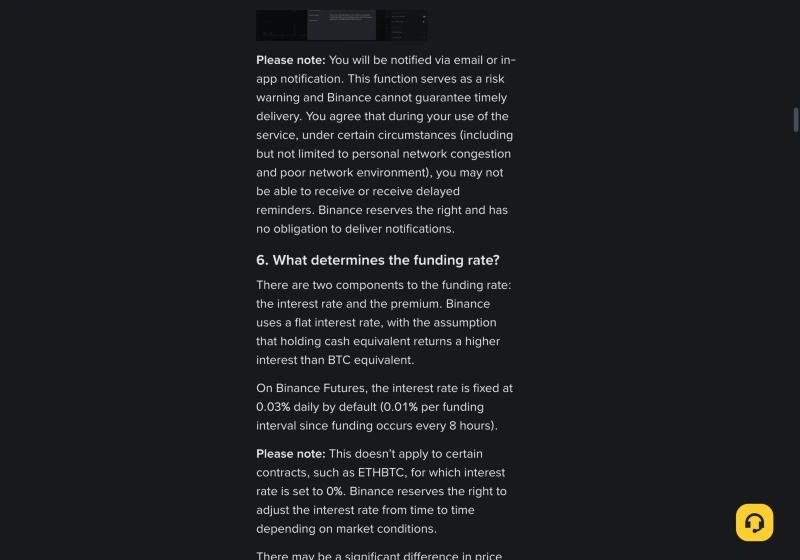
- Interest rate: a slow-moving component reflecting the difference in borrowing cost between the two currencies. Binance fixes it at 0.03% per day by default, which is 0.01% per eight-hour interval, and says some contracts such as ETHBTC use 0%.
- Premium index: how far the contract is trading above or below the index price, measured repeatedly through the funding period from the prices at which a sizeable order could be filled.
Binance combines them with a damper that keeps the difference within ±0.05%. A useful consequence follows from its formula: if the average premium sits between −0.04% and +0.06%, the funding rate comes out at exactly the interest rate of 0.01%. That is why you see +0.01% so often on Binance in calm markets. It is not a coincidence and it does not mean nothing is happening. It means the premium is inside the band where the formula returns the default.
Many contracts also have a cap and a floor, so the rate cannot exceed a set level however extreme the premium becomes. The cap is usually tied to the margin requirements of the contract. When a rate sits exactly at its cap, the real pressure may be larger than the number shows, and the contract price can stay away from the index until the premium eases.
What a funding rate tells you about the market
Because the rate follows the premium, it works as a rough reading of positioning. A persistently high positive rate usually means traders are willing to pay to stay long, which often accompanies optimism and leverage. A persistently negative rate usually means shorts are crowded or that people are hedging heavily. A rate of about +0.01% on Binance usually means little.
Treat this as context and not as a signal. A high rate can persist for days while the price keeps rising, and it says nothing about when positioning will unwind. It also differs between exchanges at the same moment because each has its own traders and its own formula. Reading one exchange and calling it the market is a common mistake, which is why the BTC funding page shows every exchange side by side.
A full worked example over one day
Take a 25,000 USDT long position on an eight-hour contract, held for exactly 24 hours across three settlements, with rates of +0.01%, +0.03% and −0.01%.
- First settlement: pay 25,000 × 0.01% = 2.50 USDT.
- Second settlement: pay 25,000 × 0.03% = 7.50 USDT.
- Third settlement: receive 25,000 × 0.01% = 2.50 USDT.
Net funding is 7.50 USDT paid, or 0.03% of position value for the day. If this position used 5× leverage, the margin is 5,000 USDT and the cost is 0.15% of margin in one day. A short of the same size would have received the same 7.50 USDT net. The example assumes a steady position value; in reality the value changes with the price at each settlement.
Common misunderstandings
- "A negative rate means the price will fall." It describes the recent premium, not the future. Negative funding can persist through a rally.
- "Funding is a fee I can avoid by choosing a cheap exchange." A lower rate helps a long and hurts a short. There is no direction-free cheapest exchange, and trading fees and execution still apply.
- "The displayed rate is what I will pay." On many exchanges the rate shown before settlement is a running estimate that can change until the settlement moment.
- "An annualised figure is a yield." It extends one reading across a year as if nothing changes. Our guide on converting funding to an annual rate explains what that number can and cannot tell you.
Check these before you hold a position through funding
- Find the settlement schedule for the exact contract, not just the exchange default.
- Check whether the rate shown is a final rate or a running estimate.
- Work out the payment on position value, then express it against your margin.
- Confirm the direction: positive means long pays, negative means short pays.
- After settlement, compare your account's funding history with your own calculation.
Related reading: What a negative funding rate means · How to compare funding rates across exchanges · Mark price vs last price
Sources
Binance · Introduction to Futures Funding Rates · Bybit · Funding fee calculation · How we measure · About Tickmark
Other guides
How to compare funding rates across crypto exchanges: 8h vs 4h settlement
You cannot compare two funding rates by looking at the percentages alone. A rate only means something once you know how often it is charged, whether you are long or short, and whether the two readings describe the same contract at the same moment. The same +0.01% costs twice as much per day on a four-hour schedule as on an eight-hour one, and it earns a short exactly what it costs a long.
What does a negative funding rate mean? Who pays, and what it does not tell you
A negative funding rate means traders holding short positions pay traders holding long positions at the next settlement. It usually happens when a perpetual contract trades below its index price, which often reflects heavy shorting or hedging. It does not mean the price is about to fall or about to rise, and it is not free income for longs, because the price can move against them by far more than the payment.
How to convert a funding rate to APR, and why the number can mislead you
To annualise a funding rate, multiply the rate per settlement by the number of settlements in a day, then by 365. A rate of 0.01% every eight hours becomes 0.01% × 3 × 365 = 10.95% a year. This puts contracts on different schedules onto one scale, which makes them comparable. It does not tell you what you will earn or pay over a year, because it assumes today's rate never changes.
Funding rate arbitrage explained: how it works and what eats the profit
Funding rate arbitrage means holding two offsetting positions in the same asset so that price moves roughly cancel, and collecting funding payments on one side. The classic version buys spot and shorts the perpetual. A second version shorts the perpetual on the exchange with the higher rate and goes long on the exchange with the lower rate. It is often described as risk free. It is not. The risks are simply different from the risk of an ordinary directional trade.
Mark price vs last price vs index price: which one liquidates you?
Perpetual futures show three prices that are easy to mix up. The last price is where the most recent trade happened. The index price is an average of spot prices across several exchanges. The mark price is an exchange's estimate of what the contract is fairly worth, and on the major exchanges it is what decides your unrealised profit and whether you are liquidated. Knowing which price does what explains why a position can be liquidated even though the chart never touched your liquidation level.
How much does a market order really cost? Fees, spread and slippage
The fee on an exchange's fee page is only part of what a market order costs. The rest comes from the price you actually receive, which depends on the direction of your trade, your order size and the depth of the order book at that moment. To compare exchanges fairly, measure the average fill price against one reference price, then add your trading fee on top, and be careful not to count the spread twice.
How to estimate slippage from order book depth before you trade
Slippage is the difference between the price you expected and the average price you actually got. You can estimate most of it before placing an order, because the order book shows how much is available at each price. Add up the levels on the side you will consume until they cover your size, calculate the average price, and compare it with the mid price. The estimate is only as good as the snapshot it came from, and books thin out at the moments you are most likely to need them.
Maker and taker fees explained: how to compare crypto exchange trading fees
A maker adds an order to the book that waits to be filled. A taker fills against an order already there. Most exchanges charge takers more than makers, because makers supply the liquidity others trade against. Comparing exchanges by the headline fee alone is misleading: you need to know which side you usually trade on, what tier your volume actually puts you in, and how the fee compares with slippage and funding on the same trade.
How to check if a crypto exchange is down: a step-by-step guide
When an exchange stops working for you, the first question is whether it is down for everyone or only for you. You can usually answer that in a couple of minutes: check the exchange's own status page, check an independent measurement, try a different network, and test the public API directly. Each source sees something different, so one green page does not prove everything is fine, and one failed request does not prove the exchange is down.
Is an exchange really down? How to read API uptime and outage records
Uptime describes the share of successful requests to particular services, over a particular period, from a particular network route. It does not establish whether you can place an order, withdraw funds or trust an exchange with your assets. A figure like 99.9% is useful only if you know what was tested, from where and for how long, so this guide explains how to read those details on our pages and on anyone else's.
What to do when a crypto exchange goes down while you have an open position
If an exchange stops responding while you hold a position, your first job is to find out what is actually broken, the second is to stop making it worse, and the third is to reduce your risk by whatever route still works. Do not keep resending the same order, because earlier attempts may have gone through. Check the mobile app and the API as alternative routes, consider hedging elsewhere if your exposure is large, and record what happened in case you need to raise it later.
Why exchange APIs reject timestamps: clock offset and stale quotes explained
A fast response can contain an old quote. Round-trip latency, clock offset and quote age describe different parts of a request, and mixing them up can make a clock mismatch look like a delayed market feed. This guide explains each one with a worked example, shows how we estimate them, and covers what to do when an exchange API rejects your request because of the time.
Binance error -1021 timestamp: causes and how to fix it
Binance API error -1021 INVALID_TIMESTAMP means the timestamp on your signed request falls outside the window Binance will accept. The message usually reads "Timestamp for this request is outside of the recvWindow" or "was 1000ms ahead of the server's time". In most cases your own clock is the cause, so the fix is to synchronise it, measure the offset against Binance's server time, and handle any remaining network delay properly. A larger recvWindow can hide the problem, but it should not be your first move.
Crypto exchange API rate limits: what error 429 means and how to stay under it
HTTP 429 means you have sent too many requests in a given time, and the server is asking you to slow down. It is not an outage. Each exchange counts requests differently: Binance uses a weight for each endpoint and bans IP addresses that keep going after a 429, Bybit blocks an IP that passes 600 requests in five seconds, and OKX sets limits per endpoint and returns error code 50011. Staying under the limit means reading the response headers, backing off properly and using WebSockets where you can.
Why an exchange API returns 403 or 451: blocks and regions
A 403 means the server understood your request and refuses to carry it out. A 451 means access is refused for legal reasons. On crypto exchange APIs, a 403 can be a web firewall, a request limit, an unauthorised key or a regional block, so the code alone does not tell you which. The response body, the exchange's documentation and a comparison from another network usually do. A real restriction applies to you for a reason, so the right response is to find out whether the service is available where you are.
Before you open a crypto exchange account: a checklist by country
Before you open an account on a crypto exchange, check four things: whether the exchange is allowed to serve people where you live, whether your country's regulator lists it, whether the site in front of you is the real one, and how the exchange has been running lately. The sign-up form takes ten minutes. Recovering from the wrong choice can take months, and sometimes it is not possible at all. This guide works through each check, using Binance and OKX as worked examples because they are the two exchanges readers ask us about most.
How to open and verify a Binance account: a step-by-step guide
Opening a Binance account takes four steps: register with an email address, a phone number or a Google, Apple or Telegram account; complete identity verification; secure the account; and make a first deposit. Registration takes a few minutes. Binance says verification is usually reviewed within 48 hours. This guide follows each step as Binance's own help pages describe it on 8 November 2026, with screenshots of those pages, and points out the details that most often cause trouble later.
How to open and verify an OKX account: a step-by-step guide
Opening an OKX account takes four steps: register with your country of residence, an email address and a phone number; complete identity verification; secure the account; and make a first deposit. OKX says it reviews verification applications within 24 hours. Which OKX company you end up with depends on where you live, and that decides the address you log in at, the fees you pay and the products you see. This guide follows OKX's own help pages as they stood on 8 November 2026, with screenshots, and flags the choices that are hard to undo. OKX shows some help pages differently by region; we read the versions served at okx.com/en-us, and the rules shown in your own account after you log in are the ones that apply to you.